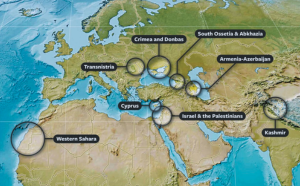
Svante E. Cornell and Brenda Shaffer examine how governments, companies, and NGOs set policy toward territories caught in protracted conflicts. Their examples range from Crimea and the West Bank to Nagorno-Karabakh and Western Sahara. They find that these policies are highly inconsistent. Goods from Jewish settlements in the West Bank must be specially labeled entering the US and EU. Goods from Nagorno-Karabakh, by contrast, enter freely as Armenian products, even though both are occupied territories under international law.
The authors trace similar double standards across sanctions, trade agreements, and the treatment of proxy regimes like Transnistria and Northern Cyprus. They also note that occupiers who expel local populations and bring in settlers often face less international pressure than Israel does. Armenia did this in Nagorno-Karabakh, and Morocco did it in Western Sahara, yet both drew less scrutiny than Israeli settlements built on new land in the West Bank.
The study is meant to help decision-makers recognize these double standards. The authors argue such standards create confusion, reveal bias, and pose real legal and business risks.