Academic & Policy Writing

Journal Articles & Analysis

Journal Articles & Analysis

Select Analysis

The Hidden Dangers of a Carbon-Neutral Military

Brenda Shaffer and Alan Howard warn that an all-electric US military could be good for the planet and bad for national security. Right now the military draws on a mix of oil, natural gas, coal, nuclear, hydropower, biofuels, wind, and solar. That mix is a strength. Narrowing it down to electricity alone would cut into that resilience.

Electrification also means leaning on rare earth minerals, and most of that supply runs through China or countries under its influence. Fossil fuels, by contrast, are abundant and spread across many parts of the world.

The authors point to specific risks for an electrified force: more exposure to cyberattacks, longer charging times than refueling takes, weaker supply lines over distance, and more opportunities for adversaries to track military movements. Mining the minerals an electric fleet would need also causes real environmental damage, which cuts against the case for going electric in the first place.

Shaffer and Howard’s bottom line: this shift would work in China’s favor, and that’s a cost worth weighing before the US commits to it.

Iran is More Than Persia

In this monograph, published by the Foundation for Defense of Democracies (April 28, 2021), Brenda Shaffer challenges the common assumption that Iran is a Persian nation-state.

She shows that Persians make up less than half of Iran’s population, and that roughly 40 percent of Iranians lack fluency in Persian, with substantial minority communities including Azerbaijanis, Kurds, Baluchs, Lurs, and Ahwazi Arabs, many of them concentrated in border provinces adjacent to their co-ethnics abroad.

Shaffer details how the Islamic Republic enforces a Persian-centric national identity, restricting minority languages in schools and government, while ethnic minority regions bear a disproportionate share of environmental degradation, water scarcity, and economic neglect. She pays particular attention to Khuzestan, Iran’s main oil-producing province, as a potential flashpoint for unrest.

The monograph also finds that Iran’s mainstream opposition largely ignores minority rights, which has kept anti-regime movements fragmented, and argues that U.S. policymakers need to take Iran’s ethnic diversity seriously as a factor in the country’s politics and stability.

Iran’s Longstanding Cooperation with Armenia

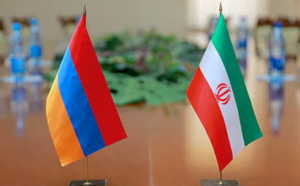
Since the Soviet collapse, Iran has quietly backed Armenia in its conflict with Azerbaijan, serving as Yerevan’s main supply route during the first Karabakh war and continuing close energy and trade ties ever since.

Brenda Shaffer argues this tilt was driven by Tehran’s fear of its own large ethnic-Azerbaijani population identifying with the newly independent Republic of Azerbaijan, but shows that domestic opposition to the policy has been building since 2017 as Iranian Azerbaijanis learn more about the extent of Iran’s cooperation with the occupying forces.

In the Era of U.S. Energy Abundance: The Role of the Caspian Region in U.S. Energy Policy

For decades, U.S. energy policy has treated allies’ energy security as a national security matter, and the Caspian region has drawn outsized bipartisan attention within that approach for over thirty years.

Brenda Shaffer traces how Washington’s engagement with Caspian energy, from the Baku-Tbilisi-Ceyhan pipeline onward, has endured even as America’s own energy abundance has grown, and asks what role the region should still play in U.S. policy now that Washington is no longer dependent on its supplies.

Is Psagot Drinking Alone? Application of the CJEU Psagot Judgement to Other Territories the EU Considers Under Occupation

Brenda Shaffer and Yael Shaffer examine a 2019 ruling by the Court of Justice of the European Union in the Psagot case. The court held that goods from Israeli settlements in the West Bank, East Jerusalem, and the Golan Heights cannot be labeled Products of Israel when sold in the EU, since the EU does not recognize Israeli jurisdiction there.

The authors ask whether this sets a general rule for all occupied territories the EU does not recognize, or whether it applies to Israel alone. They focus on Armenia’s occupation of Nagorno-Karabakh and other Azerbaijani territory as a close parallel. Armenia has built extensive settlements there, much like Israel has in the West Bank, and those territories are recognized by the UN, US, and EU as part of Azerbaijan.

Yet the authors show that products from Armenian settlements in occupied Azerbaijani territory are labeled and sold across the EU simply as Products of Armenia, with none of the scrutiny applied to Israeli settlement goods.

Occupied Elsewhere: Selective Policies on Occupations

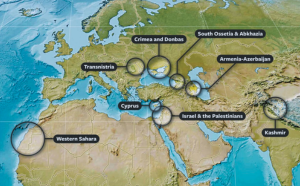
Svante E. Cornell and Brenda Shaffer examine how governments, companies, and NGOs set policy toward territories caught in protracted conflicts. Their examples range from Crimea and the West Bank to Nagorno-Karabakh and Western Sahara. They find that these policies are highly inconsistent. Goods from Jewish settlements in the West Bank must be specially labeled entering the US and EU. Goods from Nagorno-Karabakh, by contrast, enter freely as Armenian products, even though both are occupied territories under international law.

The authors trace similar double standards across sanctions, trade agreements, and the treatment of proxy regimes like Transnistria and Northern Cyprus. They also note that occupiers who expel local populations and bring in settlers often face less international pressure than Israel does. Armenia did this in Nagorno-Karabakh, and Morocco did it in Western Sahara, yet both drew less scrutiny than Israeli settlements built on new land in the West Bank.

The study is meant to help decision-makers recognize these double standards. The authors argue such standards create confusion, reveal bias, and pose real legal and business risks.

New Stage in the Global Oil Price Cycle?

Brenda Shaffer argues that 2018 marked a new phase in the oil price cycle. Prices topped $70 a barrel before settling around $65. She says the move reflects simple supply and demand, not hidden forces.

Demand is rising as global growth accelerates. Supply is strained by falling output in Venezuela and geopolitical risk in the Gulf, including tensions between Saudi Arabia and Iran. Low investment during the years of cheap oil, combined with shrinking global inventories, has tightened the market. That makes prices more sensitive to these events.

Shaffer expects the cycle to keep turning, since higher prices are already spurring more North American shale production. She also argues that OPEC’s influence over the market has been overstated.

A bigger structural shift is underway too: the US has become the world’s top oil producer for the first time since 1970. That changes how oil price swings affect the American economy. Shaffer argues Washington should now revisit long-standing policies like the Strategic Petroleum Reserve in light of that shift.

The Potential of Energy Data: A Guide to the Application of Energy Data for Intelligence Analysis

Brenda Shaffer offers intelligence and government analysts a practical guide to using energy data. She shows how figures on production, trade flows, and prices can inform political, economic, and risk assessments, especially for major oil and gas exporting states in the Middle East and beyond.

The guide draws on her work with government research units and NATO-sponsored energy security courses, where she found that even NATO member states vary widely in how they collect and apply energy data.

She walks through specific applications: using energy data to sharpen understanding of a country’s broader political and economic trajectory, to forecast energy trends like supply, demand, and prices, and to anticipate how shifts in energy revenue are likely to shape a producing state’s foreign policy and domestic stability.

Moving Pieces: European energy security amid rapidly changing geopolitical developments

Brenda Shaffer and Neil Brown examine the geopolitical shifts threatening Europe’s natural gas security, from the removal of Iran sanctions to Russia-Turkey tensions, the Syrian civil war, and instability in the South Caucasus.

The authors argue that Europe needs a clearer, more consistent natural gas policy rather than relying on market liberalization alone, and they point to the Southern Gas Corridor as a promising route for diversifying supply with Caspian gas. They also outline how the United States can support European energy security through trade provisions, backing for interconnector projects, and technical assistance to producer states.

Israel’s Energy Resource Management Policy: Lessons For Small Markets

Brenda Shaffer examines how Israel developed a management strategy for the major natural gas resources it discovered in 2009-2010, arguing that its initial approach of forming several inter-ministerial committees to weigh policy options before production and export began was unusual and useful, since most states start producing and exporting newly discovered energy resources without first formulating a clear strategy.

She notes that despite this unusually thorough planning process, and Israel’s exceptional attention to long-term domestic supply security, it still took the country more than five years to develop a full regulatory framework for its gas resources.

Shaffer contends that broader use of these reserves was slowed by two self-imposed, ideologically driven constraints: the government’s reluctance to get involved in building infrastructure, and its pursuit of a competitive gas market modeled on trends promoted internationally by the United States, the European Union, and international financial institutions, often without regard to whether competition actually served the public interest in a market of Israel’s size.

Ending the Petroleum Mystique: The Future of the Global Price of Oil

Brenda Shaffer argues that the global oil price, often assumed to be driven by hidden government or cartel machinations, is actually set by ordinary supply and demand, traded globally at a single price and prone to volatility because production cannot be quickly adjusted.

She contends that OPEC has lost much of its historical power to move the market, having fallen from 60 percent of global output in the 1970s to about 40 percent by 2000 and now unable to act meaningfully without non-OPEC producers, whose rise she identifies as the key geopolitical shift behind the 2014-2015 price collapse.

Shaffer also examines how low oil prices shape related geopolitics, including Russia’s incentive to delay the Iran nuclear deal to keep Iranian oil off the market, and points to continued Chinese economic slowdown as a factor likely to keep pressuring prices downward.

Europe’s Natural Gas Security of Supply: Policy Tools for Single Supplied States

Several European states depend on Russia as their sole supplier of natural gas, yet Brenda Shaffer’s case studies of Poland, Bulgaria, Lithuania, and Hungary show that single-supplier states can still secure adequate gas security without necessarily adding new supply sources or cutting their share of Russian gas.

She finds that the most effective strategies are state-led: expanding storage capacity, enforcing strict emergency response rules, stockpiling alternative fuels for power plants, and in some cases keeping strategic energy infrastructure under state ownership even where that means resisting EU unbundling and market liberalization rules.